Historic Downtown
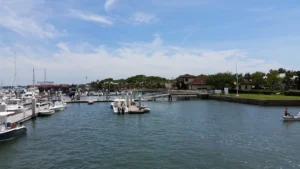
America’s oldest city center, where 460 years of Spanish, British, and American history live inside walking distance of the bay.
Historic Downtown St. Augustine
America’s oldest city center, where 460 years of Spanish, British, and American history live inside walking distance of the bay.
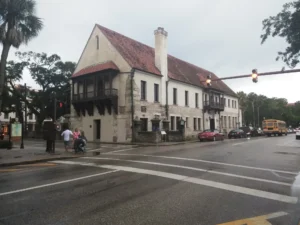
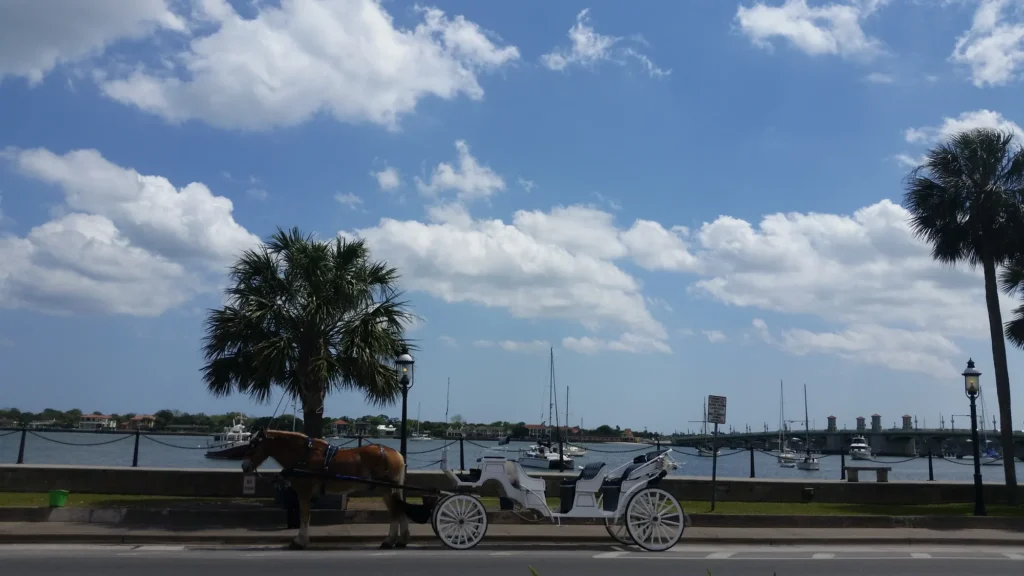
Historic Downtown St. Augustine is the part of town most visitors picture before they ever get here: the Castillo on the bayfront, St. George Street full of shops and people, horse carriages rolling past coquina walls, the Plaza shaded by old trees, church bells, balconies, brick streets, and that unmistakable feeling that the city has been standing here longer than the rest of the country has known what to do with itself.
But Historic Downtown is not just the postcard version of St. Augustine. It is not only the Castillo de San Marcos and the pedestrian blocks around St. George Street. The real historic core stretches through layers of Spanish, British, African, Minorcan, Catholic, Protestant, military, maritime, and civil rights history. Some of it is loud and obvious. Some of it sits quietly on a side street, marked by a stone, a cemetery wall, an old house, or a state park that too many visitors still miss.
To understand Historic Downtown properly, you have to understand its boundaries. St. Augustine was not just a town with a fort. It was a colonial outpost, a walled settlement, a Catholic refuge, a military prize, and, for many people fleeing slavery in the British Carolinas, a destination where freedom could become real. That is why Fort Mose Historic State Park belongs in this conversation. Fort Mose sits at the actual northern city line, at the historic boundary of St. Augustine. That marker matters. It was not near the story. It was part of the story.
Downtown St. Augustine is beautiful, yes. It is also crowded, complicated, touristy in places, deeply moving in others, and still very much alive. We love it most when visitors slow down enough to notice all of that.
Top Attractions in Historic Downtown
Downtown is where you’ll find St. Augustine’s headline attractions, the ones that put the city on every “best of Florida” list. Most can be visited in a single ambitious day, though spreading them across two days lets you actually absorb what you’re seeing instead of speed-walking through 460 years of history.
St. George Street
Colonial Quarter
Flagler College
Fountain of Youth Archaeological Park
Potter’s Wax Museum
Ripley’s Believe It or Not
Pirate & Treasure Museum
Old Jail Museum
Local tip
If you’re going to hit several paid attractions in one trip, look at the Old Town Trolley Tours pass or a multi-attraction combo ticket. The trolley alone is worth it for the on-and-off transportation between sites and the running commentary that fills in context the self-guided experience misses.
History & Culture in the Historic District
Beyond the headline attractions, downtown is layered with smaller historic sites, museums, and landmarks that reward curious visitors. Many are free or low-cost and give you a deeper read on the city than the marquee names alone. St. Augustine was founded in 1565, making it the oldest continuously inhabited European-founded city in the United States – old before Jamestown, established before Plymouth, multilingual and multiethnic from the very beginning.
Fort Mose and the Boundary of Freedom
Fort Mose Historic State Park is one of the most important historic sites in St. Augustine, and it still does not get the attention it deserves from many visitors.
Founded in 1738, Fort Mose was the first legally sanctioned free Black settlement in what is now the United States. That fact alone should put it on every serious St. Augustine itinerary. But the deeper story is even more powerful.
In 1693, Spanish Florida adopted a policy offering freedom to enslaved people who escaped from the British Carolinas, reached Spanish territory, converted to Catholicism, and pledged loyalty to the Spanish Crown. That policy was political, military, religious, and human all at once. Spain wanted to weaken the British colonies and strengthen its own defense network. But for the people fleeing bondage, the meaning was much simpler and much larger: if you could make it south, if you could survive the journey, if you could reach St. Augustine, freedom was possible.
People fled plantations in the Carolinas and moved through dangerous territory toward Spanish Florida. They faced capture, punishment, wilderness, hunger, and uncertainty. St. Augustine was not an abstract idea. It was a place on the horizon. A line. A boundary. A promise.
Fort Mose stood north of the colonial town, near the approach to St. Augustine. It was strategic because it helped defend the city from British attack. It was symbolic because it represented a legal and lived alternative to slavery in the English colonies. The people who lived there were not simply passive recipients of freedom. They formed a community, served in the militia, helped defend Spanish Florida, and built lives at the edge of empire.
This is why the northern city line matters. Fort Mose is not some disconnected site outside the “real” historic district. It helps define Historic St. Augustine. The boundary marker at the city line carries a weight that is hard to overstate. For many people, this was where the world changed.
Today, Fort Mose is a Florida State Park with interpretive programs, exhibits, reenactments, living history events, and walking areas. It is quieter than the downtown attractions – you can stand there and think without being jostled by a tour group. We recommend Fort Mose especially for visitors who want to understand St. Augustine beyond the postcard. Go before or after you visit the Castillo. One is the massive stone fort everyone photographs. The other is the place where freedom took root at the city’s edge. Both shaped this city’s identity.
Do not skip Fort Mose
Fort Mose is about a short drive north of downtown. It is not part of the walkable historic cluster, but if you care about the real history of this city, it belongs near the top of your list. Plan at least an hour – more if you like museums, birding, or living history programs.
Where to Eat in Historic Downtown
Downtown’s dining scene runs from Florida’s oldest continuously operating restaurant to craft cocktail bars in restored ice plants, with serious seafood, Spanish heritage cuisine, Southern barbecue, and quick bites all packed into a few walkable blocks. These are the picks worth planning around.
Ice Plant Bar
Prohibition Kitchen
Catch 27
Meehan’s Irish Pub
Mojo Old City BBQ
Michael’s Tasting Room
The Raintree Restaurant
Spanish Bakery & Cafe
Cousteau’s Waffles & Milkshakes
Burrito Works
Harry’s Seafood Bar & Grille
Looking for food after 10 p.m.? See the Late-Night Food Guide for what is actually open in the historic district.
Where to Stay in Historic Downtown
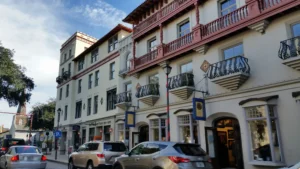
If you want to experience Historic Downtown properly, staying nearby makes a difference. Being able to walk into town in the morning or come back after dinner without fighting for parking changes the whole trip. Downtown lodging splits between historic bed and breakfasts in restored mansions, boutique hotels carved out of Gilded Age buildings, and modern brand hotels that offer reliable comfort steps from the action.
Hilton St. Augustine Historic Bayfront
DoubleTree by Hilton Historic District
St. Francis Inn B&B
Bayfront Westcott House B&B
Carriage Way Inn B&B
Casa de Sueños B&B
Renaissance St. Augustine Historic Downtown
Hampton Inn St. Augustine Historic District
Holiday Inn Express Downtown Historic
Looking for a vacation rental instead?
For families and groups, a downtown vacation rental gives you space, a kitchen, and the same walkable access without the hotel premium. First Choice Florida Vacation Rentals handles vacation rental properties throughout St. Augustine including downtown locations.
Tours & Experiences in the Historic District
Downtown is the launch point for nearly every tour in St. Augustine. Trolleys loop through it, ghost tours haunt it after dark, walking guides decode the architecture, and horse-drawn carriages clip through the brick streets. These are the ones worth your time.
Shopping in Historic Downtown
Downtown shopping isn’t about chains and outlets. It’s about local boutiques, art galleries, handmade leather, Spanish-imported goods, datil pepper everything, and the kind of one-of-a-kind finds that make better souvenirs than airport magnets.
Hidden Corners Most Visitors Miss
The best parts of Historic Downtown often sit one block off the obvious path.
Aviles Street is one of our favorite places to send visitors who want the old city without the full St. George Street crush. It is narrow, historic, atmospheric, and lined with galleries, restaurants, and old structures that feel more connected to the city’s bones. It is still visitor-friendly, but it has a different pace.
The Peña-Peck House, the Father O’Reilly House Museum, and the Spanish Military Hospital Museum are all worth knowing about, depending on your interests. Some visitors love the smaller museums because they make the city feel human-sized. You begin to understand how people lived, worked, worshiped, got sick, recovered, cooked, traded, and endured.
The Tolomato Cemetery and Huguenot Cemetery are also important, though access can be limited. Even viewing them from outside the gates reminds you how layered this place is. St. Augustine’s dead are part of the landscape, not hidden away from it.
We also recommend wandering the residential side streets south of the Plaza and around the quieter historic neighborhoods, as long as you are respectful. Do not treat people’s homes like museum exhibits. But do notice the porches, walls, gardens, plaques, and old rooflines. Some of the best downtown moments happen when you stop chasing attractions and simply walk.
And if you have not yet been to Lincolnville, the neighborhood just south and west of the historic core, that is the other place most first-time visitors overlook. It holds a different chapter of St. Augustine’s story.
Practical Tips for Visiting Historic Downtown
Parking
Parking downtown is a pain – we might as well say it plainly. The Historic Downtown Parking Facility near the Visitor Information Center is usually the easiest solution, especially for first-time visitors. Park once, then walk. Trying to move your car from spot to spot downtown is usually a mistake. Most downtown hotels include parking; vacation rentals typically have a designated spot.
Getting Around
Downtown is walkable end-to-end, but wear better shoes than you think you need. Brick streets, uneven sidewalks, heat, and slow wandering add up. The Old Town Trolley and Ripley’s Red Train both offer hop-on hop-off service. Horse-drawn carriages line up near the Plaza. Cars are inconvenient inside the district.
Best Time to Visit
Weekday mornings are quietest. Midday can be hot, crowded, and harsh for photos. Summer weekends are thick with people. Nights of Lights season is beautiful, but it is also one of the busiest times of the year. Spring and fall offer the best weather. If you come during a peak period, plan around the crowds instead of pretending they will not exist.
How Long to Spend
Give yourself at least half a day for the downtown core and a separate block of time for Fort Mose. If you are trying to do the Castillo, St. George Street, the Plaza, lunch, a museum, and Fort Mose all in one rushed afternoon, you will technically see things but not absorb much. A good first visit: Fort Mose in the morning, then the Old City Gates and colonial core afterward. That route gives the city a stronger narrative: boundary, arrival, defense, settlement.
The Guide’s Take
Historic Downtown St. Augustine is one of those places that can be exactly as shallow or as deep as you allow it to be.
You can come here, take a picture of the Castillo, buy a souvenir, eat something sweet, walk St. George Street, and have a perfectly nice day. There is nothing wrong with that. But the city offers more.
This is a place where Spanish colonial power, Catholic mission history, African freedom, British ambition, Minorcan survival, maritime trade, tourism, preservation, and everyday local life all sit on top of each other. The same walk can take you past a fortress, a cathedral, a government building, a cemetery, a restaurant, a ghost tour, and a street musician. That mix is not accidental. It is St. Augustine.
Fort Mose reminds us that the story of Historic Downtown does not stop at the prettiest blocks. The northern boundary of the old city is part of its meaning. For many people, that line represented freedom. That should change the way we see the whole place.
So yes, come for the old streets and the view across the bay. We still love those. But give the city enough time to speak in its full voice. Historic Downtown is not just old. It is layered, difficult, beautiful, and still unfolding. That is why people come here once and keep thinking about it long after they leave.
Beyond Historic Downtown
Read our history: Historic Downtown St. Augustine: The Colonial Core, the Old City Line, and the Story Beneath the Cobblestones
Live rates and availability in St. Augustine: Search and prices from Expedia and Vrbo. We may earn a commission at no extra cost to you.
Where to stay
 Hilton St. Augustine Historic Bayfront
 Casa Monica Resort & SpaCasita 1860
.jpg) Renaissance St. Augustine Historic Downtown Hotel
Renaissance St. Augustine Historic Downtown Hotel.jpg) Spark by Hilton St. Augustine Historic District
Spark by Hilton St. Augustine Historic District.jpg) Hotel Amalga, St. Augustine – A Tribute Portfolio Hotel
Hotel Amalga, St. Augustine – A Tribute Portfolio Hotel.jpg) voco St. Augustine Historic Area by IHG
voco St. Augustine Historic Area by IHG.jpg) Homewood Suites by Hilton St. Augustine San Sebastian
Homewood Suites by Hilton St. Augustine San SebastianBook a stay