
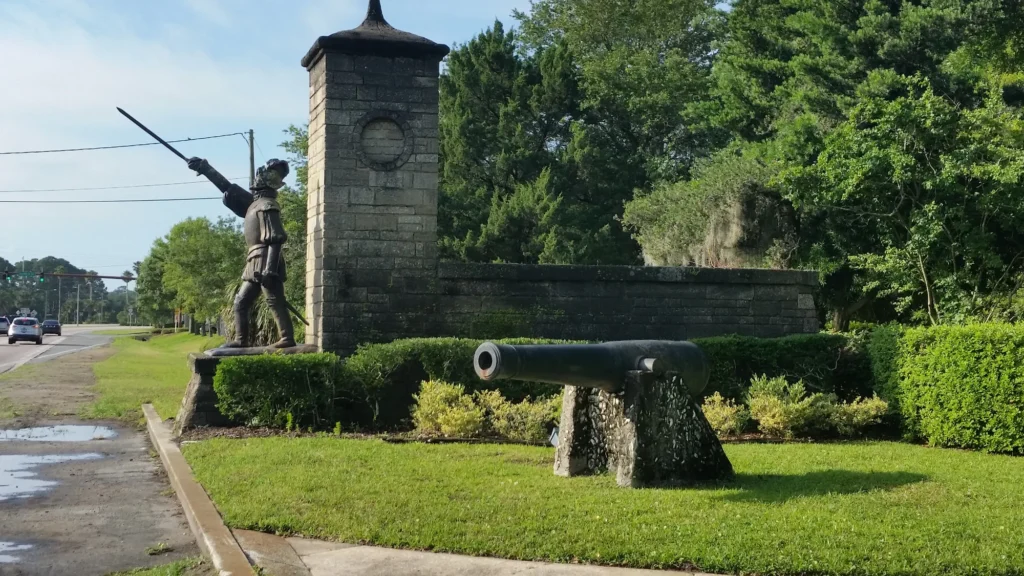
Uptown
The northern doorway most visitors drive through without stopping – and the home of one of the most important historic sites in the city.
Uptown St. Augustine
The northern doorway most visitors drive through without stopping – and the home of one of the most important historic sites in the city.
Uptown St. Augustine is not the part of town most visitors come here picturing. It does not have the easy postcard shine of the bayfront. It does not have the beach air of Anastasia Island or the polished vacation feel of Vilano Beach. A lot of people experience Uptown only through a windshield: turning off US 1, coming down San Marco Avenue, passing shops, restaurants, offices, old neighborhoods, the jail district, and the courthouse side of town, then suddenly realizing they are almost downtown.
But that is exactly why Uptown matters. This is the inland northern district of St. Augustine – the practical doorway into the city and one of the places where the official tourist version of town starts to thin out. It is where daily local life, regional traffic, court business, neighborhood streets, roadside restaurants, and deep history overlap.
Fort Mose Historic State Park sits at this northern edge of St. Augustine, and it is one of the most important historic sites in the entire city. Founded in 1738, Fort Mose was the first legally sanctioned free Black settlement in what is now the United States. That is not a side note. It is central to the story of St. Augustine. Most visitors rush toward the Castillo, St. George Street, and the Plaza. We understand why. But Uptown tells another story: the story of arrival, boundary, defense, survival, and freedom.
Fort Mose Historic State Park
Fort Mose is the reason Uptown belongs on any serious St. Augustine itinerary. The 40-acre waterfront park preserves the site of Gracia Real de Santa Teresa de Mose – established by the Spanish in 1738 as the first legally sanctioned free Black settlement in what would become the United States. A visitor center and museum, interpretive boardwalk, picnic areas, kayak access, and birding habitat make it a full visit, not just a marker.
To understand why Fort Mose mattered, you have to go back before 1738. In 1693, Spanish Florida offered freedom to enslaved people escaping from the British Carolinas if they reached Spanish territory, converted to Catholicism, and pledged loyalty to Spain. That policy was partly military strategy, partly religious mission, and partly imperial rivalry. But for the people making the dangerous journey south, it meant something much more direct: St. Augustine was a place where freedom could become real.
People fled plantations in the Carolinas and moved through dangerous ground toward Spanish Florida. They risked capture, punishment, hunger, violence, and failure. They were not walking toward an abstract legal policy. They were walking toward a boundary – a place that could change their lives.
Fort Mose was strategic: it helped defend the northern approach to St. Augustine against British attack. But it was also symbolic in the deepest possible sense. Those who reached this place had crossed into a different legal world. They could form families, build a settlement, serve in the militia, worship, work, and live as free people under Spanish authority. It was real, and it mattered enormously.
Visiting Fort Mose today is different from visiting the Castillo or walking St. George Street. It is quieter. The landscape asks more of you. The boardwalk gives you a sense of the marshy environment that shaped the site. Living history events and interpretive programs help bring the story into focus throughout the year. For more on this history, see our Black history in St. Augustine guide.
Give Fort Mose real time
Do not treat it like a quick checkbox between lunch and shopping. Walk the grounds. Read the exhibits. Think about what it meant to approach St. Augustine from the north, knowing that this boundary could mean freedom. Fort Mose is not “near” the story of St. Augustine. It is part of the city’s defining story.
The City Gates and the Northern Boundary
When most visitors think of a northern entrance to old St. Augustine, they picture the Old City Gates at the north end of St. George Street. The coquina pillars are one of the most recognizable landmarks in the historic district and mark the old fortified entrance into the walled colonial town.
The current gates date to 1808, when the Spanish reconstructed the northern wall – known as the Cubo Line – after regaining Florida from the British. The gate was part of the fortified defenses meant to protect St. Augustine; restored wall sections can still be seen nearby.
But there is a useful distinction to hold in mind. The Old City Gates mark the entrance into the old walled colonial core. Fort Mose, farther north, sits at the larger historic northern boundary of St. Augustine – where the meaning of arrival changes entirely. One boundary was about controlling access into the fortified town. The other was about the edge of Spanish Florida and the promise of freedom for those who made it there. St. Augustine has more than one doorway. The tourist doorway is the City Gate. The deeper historic doorway is Fort Mose.
The Northern Corridor Today
Uptown today is not a polished little visitor district. It is a mix, and that is part of the point.
Along San Marco Avenue and the US 1 corridor, you get an everyday St. Augustine rhythm: restaurants, small businesses, legal offices, service businesses, regional shopping, traffic lights, neighborhoods, and people going about normal lives. It is not as visually tidy as the historic core. It is not as scenic as the beach. It is not trying very hard to impress you.
The Old Jail Museum on San Marco Avenue gives visitors a look at late 19th- and early 20th-century penal history in St. Augustine. It is more theatrical than Fort Mose – we would not put them in the same historical category – but it is a worthwhile stop if you like old roadside attractions, guided tours, or darker local history. It is also easy to combine with the broader San Marco Avenue corridor as you move between Fort Mose and downtown.
Farther north and inland, the St. Augustine Regional Airport area expands the sense of Uptown as a working corridor rather than a purely historic one. That is the honest character of this district: partly historic, partly practical, partly overlooked, and very much alive.
What to Do in Uptown
Start with Fort Mose. Plan enough time for the visitor center and museum, then walk the boardwalk and grounds. If there is an interpretive program or reenactment happening, that is the best time to go – Fort Mose rewards context. The more you understand before you walk the site, the more powerful the visit becomes.
The Old Jail is the other obvious visitor stop in the area. After Fort Mose and the Old Jail, approaching Historic Downtown via the northern end of St. George Street and the Old City Gates gives the city a stronger narrative: boundary, arrival, defense, settlement. We like this direction better than arriving from the parking garage side.
Pair Fort Mose with the Castillo
One is the massive stone fort everyone photographs. The other is the place where freedom took root at the city’s edge. Both defended St. Augustine. Both shaped its identity. Visit them on the same trip and the city’s full story comes into focus.
Practical Tips for Visiting Uptown
Getting There & Parking
Uptown is easiest by car. Fort Mose Historic State Park has its own free parking lot – a rare luxury in St. Augustine. The Old Jail area has visitor parking as well. From Historic Downtown, take San Marco Avenue north; Fort Mose is about a 10-minute drive.
How Long to Spend
Give Fort Mose at least an hour, more if you like museums, birding, or photography. If you are combining Uptown with downtown, go to Fort Mose in the morning, then the Old City Gates and colonial core afterward. That sequence gives the city a much stronger narrative arc.
What to Expect
Fort Mose is quieter than the downtown attractions. You will not find the crowds of St. George Street. That is part of what makes it powerful. The boardwalk is easy walking; wear comfortable shoes and bring water in warmer months. The marsh environment can feel hotter than the coast.
Programs & Events
Fort Mose holds living history events, reenactments, and interpretive programs throughout the year. Check the Florida State Parks website before visiting if you want to time your visit around one. The park grounds are free to enter; the visitor center and museum charge a small fee.
The Guide’s Take
Uptown is not the prettiest part of St. Augustine. That is not an insult. It is just the truth.
It does not give you the instant romance of Aviles Street or the bayfront view from the Castillo green. It does not smell like salt air the way the beach side does. It is a working, driving, shopping, living corridor with history embedded in it rather than displayed neatly for tourists.
But that is exactly why it matters. Most visitors pass through Uptown without realizing they are moving through one of the most meaningful edges of the city. Fort Mose changes the way we understand St. Augustine. It reminds us that this city was not only a Spanish military post or a charming colonial town. It was also a destination for people seeking freedom – a place where the boundary itself carried life-changing meaning.
So yes, go downtown. Walk St. George Street. See the Castillo. We still love those places. But slow down before you get there. Stop at Fort Mose. Pay attention to the northern doorway. Uptown tells a quieter story, but it is one of the stories that makes St. Augustine worth understanding. For more on this history, see our Black history in St. Augustine guide and the Lincolnville area page.
Read our history: Uptown St. Augustine: The Northern Doorway Most Visitors Drive Right Past
Live rates and availability in St. Augustine: Search and prices from Expedia and Vrbo. We may earn a commission at no extra cost to you.
Where to stay
Book a stay

.jpg)
.jpg)
.jpg)
.jpg)
.jpg)
.jpg)