
Oldest Wooden School House
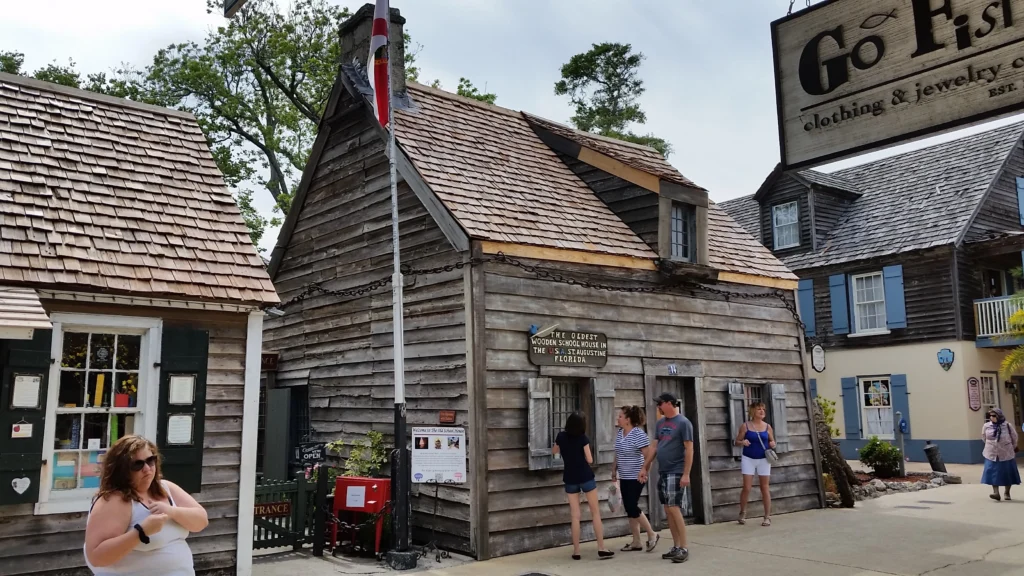
Step into colonial education at the Oldest Wooden School House, a remarkable surviving structure that has been teaching visitors about 18th-century life for more than 300 years. Located at 14 St. George Street near the historic City Gates, this charming hand-built cedar and cypress building first appears in tax records from 1716, making it one of the oldest surviving wooden structures in St. Augustine and among the nation’s most historic educational buildings. While the exact construction date remains unknown, historians believe it was built in the early 1700s following the British burning of St. Augustine in 1702, which destroyed all earlier wooden structures in the city.
The building’s unique construction methods showcase colonial ingenuity and resourcefulness. Constructed entirely of red cedar and cypress wood, two naturally rot-resistant species ideal for Florida’s humid climate, the schoolhouse was assembled using wooden pegs and hand-forged iron nails rather than modern fasteners. These traditional techniques ensured the structure could flex and move during hurricanes and severe weather without collapsing. The most distinctive feature visible from St. George Street is the massive chain encircling the entire building, installed in 1937 to anchor the structure to the ground as hurricane protection. This unusual safety measure has become one of the schoolhouse’s most photographed features, creating a striking visual that immediately captures visitors’ attention.
Originally built for the Genoply family in what was then known as the Minorcan Quarter, the building served dual purposes as both family residence and classroom. The schoolmaster Juan Genopoly and his wife lived upstairs in modest quarters above the single-room classroom, while students gathered downstairs for their lessons. This arrangement was typical of the period, when teachers often operated small private schools from their homes. The compact classroom could accommodate only a handful of students at a time, providing an intimate learning environment vastly different from modern educational settings.
Today’s visitors experience the schoolhouse through animated mannequins that bring colonial education to vivid life. The schoolmaster figure, dressed in period clothing, welcomes guests and explains 18th-century teaching methods, subjects, and classroom management techniques. Student mannequins demonstrate how children sat at simple wooden desks, wrote on slates with chalk, and learned reading, writing, arithmetic, and religious studies. The attention to detail in these displays helps visitors, especially children, understand how different education was in colonial times compared to today’s high-tech classrooms.
One of the most fascinating features is the dunce area beneath the stairway, a small confined space where misbehaving students were sent as punishment. This tiny cell-like room, visible through bars, illustrates the strict discipline methods common in colonial education when corporal punishment and public humiliation were accepted teaching tools. Modern children often express shock at these harsh measures, leading to valuable discussions about how educational philosophy and child-rearing practices have evolved over centuries.
The schoolhouse displays reproduction textbooks, slates, maps, and other educational artifacts that show what subjects were taught and how students learned without electricity, computers, or modern conveniences. Hornbooks, which were paddle-shaped wooden boards with printed lessons covered by thin transparent horn, served as early primers for teaching reading. Students memorized lessons, practiced penmanship, and learned through rote repetition, quite different from today’s interactive educational methods.
The detached kitchen behind the main building represents another important aspect of colonial architecture. Kitchens were deliberately separated from living quarters to keep homes cooler during Florida’s sweltering summers and to prevent fires that started during cooking from spreading to the main house. This kitchen displays period cooking implements and explains how families prepared meals using fireplaces, cast iron pots, and foods available in colonial St. Augustine.
The Historic Museum and Gardens at the Oldest Wooden School House preserve this unique Minorcan homestead while providing educational, recreational, and entertainment experiences for families and students. The self-guided tour takes 20 to 30 minutes, making it an excellent quick stop during a walking tour of St. George Street. All visitors receive a commemorative diploma upon completing their visit, a fun keepsake that especially delights younger guests.
The 250-year-old pecan tree on the property adds natural beauty and historical significance, having stood witness to centuries of St. Augustine’s evolution. This magnificent tree, which was already mature when American patriots fought the Revolutionary War, provides shade and a connection to the countless generations who have passed beneath its branches.
Good to know
- • Dates back to early 1700s (first recorded 1716)
- • Among America's oldest surviving school buildings
- • Hand-built with red cedar and cypress wood
- • Assembled with wooden pegs and hand-forged nails
- • Famous protective chain anchoring to ground (added 1937)
- • Located in historic Minorcan Quarter
- • Original one-room colonial schoolhouse
- • Animated mannequins depicting teacher and students
- • Schoolmaster and wife lived upstairs
- • Dunce area under stairs for punishment
- • Reproduction textbooks and educational artifacts
- • Period slates, hornbooks, and teaching materials
- • Detached kitchen building behind school
- • 250-year-old pecan tree on property
- • Self-guided tour (20-30 minutes typical)
- • All visitors receive commemorative diploma
- • Educational for children and adults
- • School field trip friendly
- • Near Old City Gates entrance
- • On pedestrian-only St. George Street
- • Gift shop with colonial-themed items
- • Historic gardens to explore
- • Wheelchair accessible main floor
- • Open daily year-round
- • Perfect quick stop during historic walking tour