
Castillo de San Marcos
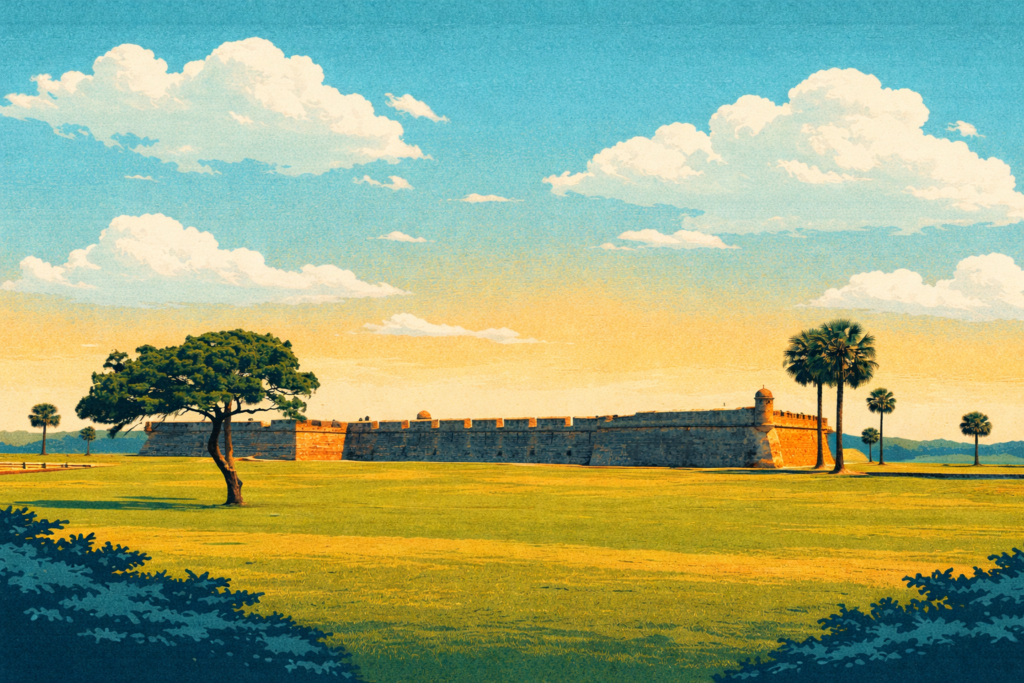
The Castillo de San Marcos: Heart of the Nation’s Oldest City
When visitors walk along the waterfront of St. Augustine, their eyes are inevitably drawn to a fortress of pale stone rising over Matanzas Bay. The Castillo de San Marcos is more than a tourist stop. It is the story of Florida itself, a monument to centuries of ambition, struggle, and survival. For more than 300 years it has stood, weathering storms, sieges, and the slow turning of history. To understand St. Augustine is to understand the Castillo.
Origins in Empire
The roots of the Castillo stretch back to the great imperial rivalries of the sixteenth and seventeenth centuries. Spain founded St. Augustine in 1565 as a defensive outpost against rival European powers. For more than a century the settlement clung to life behind wooden palisades that were burned or destroyed time and again. English raiders under Sir Francis Drake torched the town in 1586, and other attacks followed. By the 1660s it was clear that if Spain wanted to hold Florida, it needed a permanent fortress.
Construction began in 1672. The engineers who designed it followed the cutting-edge science of their time, laying out a star-shaped bastion fort that could repel cannon fire from any direction. But the true innovation came not from design, but from material.
Coquina: The Stone that Saved St. Augustine
Instead of granite or marble, Spain’s builders turned to coquina, a porous limestone made of compressed seashells. It was quarried from nearby Anastasia Island and ferried across the bay. Coquina seemed weak at first glance, but when struck by cannonballs it compressed and absorbed the impact instead of shattering. This strange stone gave St. Augustine a fortress that was, for all practical purposes, indestructible.
It took twenty-three years of labor by Spanish soldiers, convicts, and Native peoples forced into service. When the fort was finished in 1695, the town of St. Augustine finally had a permanent shield against its enemies.
A Stage for Colonial Conflict
The Castillo immediately became a prize in the contest between empires. English forces from Carolina besieged it in 1702, surrounding the town with fire. The residents of St. Augustine huddled inside the new stone walls for two months while British troops tried in vain to break through. When reinforcements arrived from Havana, the siege was lifted. The Castillo had proved its worth.
In 1740, James Oglethorpe of Georgia brought another siege, again without success. The coquina walls held. For Spain, the Castillo was proof that their hold on Florida could endure.
Yet empire is never permanent. In 1763, Spain ceded Florida to Britain as part of the Treaty of Paris. The Castillo was renamed Fort St. Mark and held under the British flag for twenty years. In 1784, after the American Revolution, the Spanish regained control. The back-and-forth of empire was written directly onto its walls.
The American Era
In 1821 Florida passed into the hands of the United States. The Castillo was renamed Fort Marion, after Revolutionary War hero Francis Marion. The U.S. Army used it as both a coastal defense and, tragically, a prison. During the Seminole Wars, Native Americans including the legendary Osceola were held within its cells. Later, members of western tribes such as the Apache were confined there.
This part of the Castillo’s history is not celebrated, but it is essential. The same stone walls that sheltered Spanish townsfolk also confined Native peoples in exile. The Castillo embodies both survival and suffering.
A Symbol of Survival
By the late nineteenth century, the fort was no longer a military necessity. Advances in artillery made masonry fortresses obsolete. But rather than being abandoned, it began to take on a new role as a historic site. Visitors came to see its ramparts and to reflect on its past. In 1924 it was declared a National Monument, and in 1942 its original name, Castillo de San Marcos, was restored.
Today it is managed by the National Park Service, preserved not as a weapon of war but as a witness to history. Schoolchildren walk the same drawbridge where soldiers once stood guard. Families climb the bastions where cannons pointed out over the bay. Historians study its design as one of the finest examples of Spanish colonial military architecture in the Americas.
Why the Castillo Matters
The Castillo de San Marcos is not just a relic. It is a touchstone of American identity. Its coquina walls speak to resilience. Its layered history reflects the collisions of empire, culture, and ambition that shaped the continent. Spanish, British, American, Native – all left their mark.
For St. Augustine, it is more than a landmark. It is the beating heart of the city. The Castillo embodies St. Augustine’s claim as the oldest continuously occupied European settlement in the United States. It reminds us that history here is not distant. It is tangible, written into the very stone.
Closing Reflection
Standing on the ramparts of the Castillo de San Marcos, you can look out across Matanzas Bay and imagine the sails of enemy ships on the horizon. You can look down at the old town and see how the fort has sheltered it for centuries. More than three hundred years after it was built, the Castillo still defines St. Augustine.
It is a monument not only to military power, but to endurance, memory, and identity. To visit the Castillo is to walk through centuries of history and to leave with a deeper sense of what America’s first city truly represents.