
The Castillo Beyond the Postcard: What Most Visitors Miss About America’s Oldest Masonry Fort
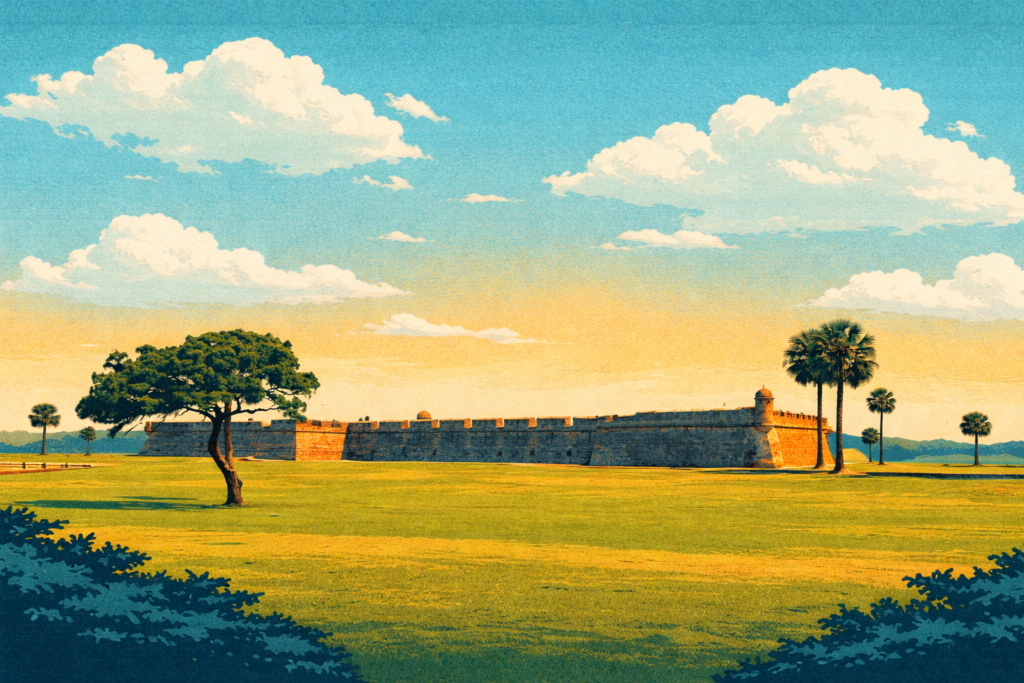
Most visitors meet the Castillo de San Marcos the same way: they walk up from downtown, cross the green, take a few photos of the walls, maybe watch a cannon demonstration, and say some version of, “Wow, this place is old.”
And fair enough. It is old. The Castillo is the oldest masonry fortification in the continental United States, built by the Spanish to defend St. Augustine and the Atlantic trade routes of their empire. The National Park Service describes it as a place that preserves more than 450 years of cultural intersections, which is a very official way of saying: a lot happened here, and not all of it is easy.
But the Castillo is more than a beautiful stone fort on Matanzas Bay. It is a military machine. It is an engineering gamble that worked better than anyone expected. It is a survival story. It is also a prison, a symbol of empire, and a place where some of the hardest chapters in American history are still sitting inside the walls if you know how to look.
The fort made out of shells
The first thing to understand is the stone. The Castillo is built from coquina, a local shellstone quarried primarily from Anastasia Island. Coquina is made from ancient shells, especially tiny coquina clam shells, that settled in layers, hardened over time, and became a porous limestone. The Spanish did not choose it because it was perfect. They chose it because it was available. In colonial Florida, that mattered.
Wooden forts had already failed St. Augustine. The city had been burned and attacked before. A serious stone fort was needed, and coquina was the stone they had. Construction began in 1672, with coquina quarried on Anastasia Island, mortar made from burned oyster shells, and labor that included soldiers, craftsmen, convicts, and workers brought from Spanish territories including Cuba.
The surprise was that coquina turned out to be brilliant under fire.
Hard stone can shatter when hit by cannonballs. Brick can splinter. Coquina behaves differently. Because it is full of tiny air pockets, it compresses. Cannonballs could bury themselves into the wall or bounce away instead of exploding the surface into fragments. That is the famous “the bullets sink into the stone” story, and it is not just tourist folklore. The National Park Service explains that cannonballs fired at the Castillo’s coquina walls often burrowed into the rock rather than breaking it apart.
That does not mean the fort was magic. It means the Spanish accidentally ended up with a material that matched the problem. The walls were also massively thick, averaging about 12 feet, with some ocean-facing sections even thicker. The seashell stone worked because it was paired with scale, geometry, and patience.
Spanish engineering: not a castle, a weapon
The Castillo looks romantic now, especially at sunset. But it was not built to be pretty. It was built according to a European military logic shaped by cannon warfare.
Its star-shaped design, with diamond-like bastions at the corners, was part of the bastion system that developed after gunpowder changed war. Tall medieval walls were no longer enough. Forts needed lower, thicker walls, angled positions, overlapping fields of fire, and platforms where cannons could cover the approaches. The Castillo is a North American example of that engineering tradition, influenced by the same broad military thinking associated with European fortification systems of the era.
Stand on the gun deck and look at the corners. Those bastions are not decorative. They allowed defenders to fire along the walls and cover blind spots. The moat, which was historically dry, was another layer of defense. The interior rooms, called casemates, were not just atmospheric old chambers. They stored powder, food, soldiers, prisoners, and civilians during crisis.
This is one of the things visitors miss. The Castillo was not just defending itself. It was defending a whole town. During siege conditions, St. Augustine’s residents could crowd into the fort and wait out attack. It was the last hard point of Spanish Florida.
The sieges: why the fort survived
The Castillo was tested quickly.
In 1702, during Queen Anne’s War, English forces from Carolina under Governor James Moore attacked St. Augustine. The Spanish evacuated people, supplies, and livestock into the Castillo. According to the National Park Service, by November 10, nearly 1,500 people had taken refuge inside the fort. The English captured and burned the town but could not take the fortress. Their smaller cannons were ineffective, and when Spanish relief ships arrived from Havana, the siege collapsed.
That pattern matters. The Castillo did not save the town from destruction. St. Augustine burned. But the fort preserved the Spanish population, the garrison, and Spain’s control of Florida. That is a different kind of survival.
In 1740, James Oglethorpe of Georgia tried again. This time the attack came during the War of Jenkins’ Ear, a conflict wrapped in imperial rivalry, trade disputes, smuggling, and British-Spanish tension. Oglethorpe’s forces surrounded St. Augustine and bombarded the Castillo for nearly a month. Once again, coquina helped. A contemporary English observer compared the effect to sticking a knife into cheese, because the native stone absorbed cannon fire instead of splintering. Each night, Spanish defenders repaired and covered damage from the day’s bombardment. Eventually Oglethorpe withdrew.
That is the part we always come back to: the Castillo was never taken by force. Florida changed hands, but not because an army stormed these walls. It changed hands by treaty, politics, and empire.
From Castillo to Fort St. Mark
In 1763, after the Seven Years’ War, Spain gave Florida to Britain in exchange for the return of Havana and Manila. The British took possession of St. Augustine, and the Castillo became Fort St. Mark. The name change is more than a label. It tells you how each empire tried to make the place its own.
Under the British, St. Augustine became the capital of East Florida. The city changed. British settlers arrived. Spanish houses were altered. Plantation agriculture expanded. Slavery was openly encouraged as part of the British colonial economy. During the American Revolution, East Florida stayed loyal to Britain, and Fort St. Mark became a military supply base and prison. Christopher Gadsden of South Carolina was imprisoned in the fort, while other Revolutionary figures were held in town.
So when visitors think of the Castillo only as “Spanish,” they are missing a whole British layer. It was Spanish in origin, but the walls watched flags change and identities get rewritten.
Fort Marion and the Civil War
After Florida became part of the United States, the fort was renamed Fort Marion. By the Civil War, it was no longer the cutting-edge defensive machine it had once been. It was more of a military storehouse, holding old cannons and supplies.
In January 1861, just before Florida formally seceded, Florida militia came to take the fort. The entire Federal garrison was basically one man, Ordnance Sergeant Henry Douglas. He surrendered the fort only after demanding a receipt for its contents. That is such a St. Augustine detail: the Confederacy took the old Spanish fortress, and the guy in charge wanted paperwork.
During Confederate control, Fort Marion served as a supply and transit point. Most of its cannons were moved elsewhere, leaving only a handful behind. In 1862, Union forces arrived off St. Augustine, Confederate troops withdrew, and the city returned to Union control without a major fight. For the rest of the war, St. Augustine saw occupation, patrols, convalescent soldiers, and military routine rather than a dramatic fort battle.
The Civil War chapter is quieter than the sieges, but it matters. The Castillo had gone from Spanish imperial shield to British stronghold to American military property to Confederate possession and back again.
The uncomfortable history: Native prisoners at Fort Marion
This is the part that should not be skipped.
In the 1800s, Fort Marion was used repeatedly as a prison for Native Americans. This includes Seminole prisoners during the Second Seminole War, Plains prisoners from Cheyenne, Arapaho, Kiowa, Comanche, and Caddo communities, and later Apache prisoners.
In 1837, Seminole leaders, warriors, and families were captured after being summoned under the pretense of a peaceful parley under a white flag of truce. More than 230 prisoners were eventually held at Fort Marion. Osceola, the famous Seminole war leader, was among them, though he was later moved to Fort Moultrie in South Carolina, where he died. Coacoochee, also known as Wild Cat, escaped from Fort Marion with other prisoners, a story still debated in its details but powerful in Seminole memory.
From 1875 to 1878, 74 prisoners from Plains tribes were held at Fort Marion after the Red River War. Conditions were bleak at first: chains, guards, confinement in casemates, uncertainty, and fear. Richard Henry Pratt later took charge and introduced education, military drills, uniforms, and assimilation practices. This Fort Marion experience helped shape Pratt’s later work at the Carlisle Indian Industrial School, one of the most infamous institutions in the history of Native American forced assimilation.
Then came the Apache prisoners. In 1886, more than 500 Apache were imprisoned at Fort Marion after years of resistance to U.S. Army campaigns and forced relocation. Here we need to be precise: Geronimo himself was separated and held at Fort Pickens near Pensacola, but members of his band, including family members, were imprisoned at Fort Marion. The NPS notes that the group held at the Castillo had fought with leaders including Chihuahua, Naiche, and Geronimo, and that over 500 Apache eventually saw the inside of these walls.
The fort was overcrowded. The NPS says the military placed 502 Apaches in a space suited for roughly 150 people, with many living in tents on top of the fort. Illness was constant. Twenty-four Apache died and were buried somewhere on North Beach, today’s Vilano area.
That is not a side note. That is part of the Castillo.
What to look for when you visit
When we walk visitors through the Castillo, we always tell them to slow down. Do not just take the wide shot from the green and move on.
Look closely at the coquina. You can see the shells. The whole fort is made from the beach, basically, hardened into empire.
Stand in the courtyard and imagine 1,500 people packed inside during the 1702 siege. Not soldiers only. Families. Children. Livestock nearby. Smoke rising from the town outside.
Walk the gun deck and study the angles. The view is beautiful now, but those sightlines were designed for violence. Every corner had a job.
Step into the rooms and remember they were not always empty interpretive spaces. They were storerooms, barracks, classrooms, prison cells, and holding spaces for people who did not choose to be here.
Look for the Native incarceration interpretation. The NPS has been more direct in recent years about telling those stories, including the legacy of Plains ledger art and Apache carvings left in the coquina. The fort is not just preserving walls. It is preserving evidence.
Why the Castillo matters today
The Castillo survives because it is useful in a different way now.
It no longer guards Spanish treasure fleets. It no longer holds prisoners. It no longer changes flags with each imperial negotiation. Today, the National Park Service preserves it as a national monument, not because the story is simple, but because it is not. The site preserves military engineering, colonial rivalry, Spanish Florida, British East Florida, the American takeover, the Civil War, Native imprisonment, tourism, archaeology, architecture, and memory all in one place.
That is why we think the Castillo is worth more than a quick stop.
It is the postcard image of St. Augustine, yes. But it is also a test of how honestly we are willing to read a place. The walls are beautiful. The bayfront is beautiful. The stone glows in the evening light. And inside that same stone are stories of refuge, survival, conquest, imprisonment, resistance, and preservation.
That is the real Castillo. Not just America’s oldest masonry fort. One of America’s most layered historic places.