
Ximenez-Fatio House
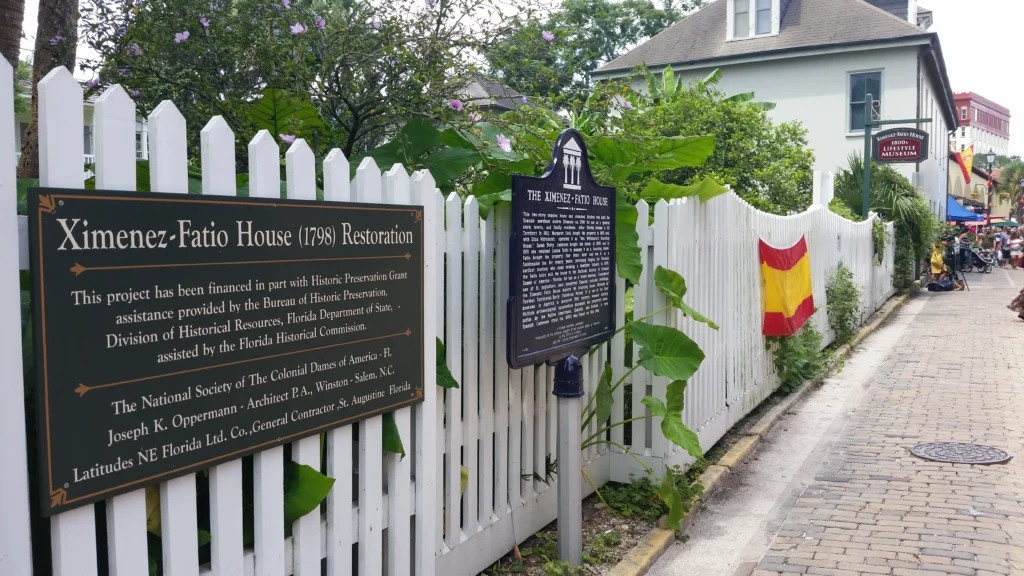
The Ximenez-Fatio House on Aviles Street is one of the most authentically preserved historic buildings in St. Augustine – a coquina stone merchant’s home built in 1798 that spent most of the 19th century as the city’s most fashionable boarding house, operated by a remarkable succession of businesswomen during an era when female commercial ownership was exceptionally rare.
The house was built by Andres Ximenez, a Spanish merchant, during the Second Spanish Period. After Florida became an American territory in 1821, St. Augustine transformed into an early tourist destination – a place where wealthy Northerners escaped winter and where doctors sent patients with respiratory ailments to benefit from the mild climate. The Ximenez house became a boarding house to serve this new visitor economy, hosting individuals, families, sea captains, soldiers, politicians, and adventurers in an establishment that was considered the finest in the city.
What makes the Ximenez-Fatio House remarkable in historical context is that it was owned and operated by a succession of women across its decades as a boarding house – Margaret Cook, Sarah Petty Anderson, and finally Louisa Fatio, whose name became permanently attached to the property. Fatio purchased it in 1855 and operated it with distinction until her death. The house became known as Miss Fatio’s and achieved a reputation that extended well beyond St. Augustine. In an era when women rarely owned businesses, these proprietresses built and maintained one of Florida’s most respected commercial establishments.
The National Society of Colonial Dames purchased the building in 1939 and worked with the National Park Service and the State of Florida to restore and preserve it. The restoration recreates the boarding house as it appeared during its heyday from the 1830s through the 1850s, with every room telling a specific story about the guests who stayed there and the women who ran it.
Today the Ximenez-Fatio House offers docent-guided tours at 11:00am and 3:00pm Tuesday through Saturday, plus self-guided audio tours available until 3:45pm. Archaeological artifacts found on the property during University of Florida excavations are displayed throughout. Specialty tours cover topics from the lives of enslaved people in antebellum St. Augustine to the colonial gardens to candlelit after-hours ghost experiences. The museum also hosts pottery classes, lecture series, and special events throughout the year.
Highlights:
– Coquina stone merchant’s home built in 1798 – one of St. Augustine’s oldest buildings
– Restored to its 1830s-1850s boarding house appearance
– Operated by a succession of businesswomen in an era of rare female commercial ownership
– Known as Miss Fatio’s – the most fashionable boarding house in antebellum St. Augustine
– Owned by the National Society of Colonial Dames since 1939
– Archaeological artifacts from University of Florida excavations on display
– Docent-guided tours Tue-Sat at 11am and 3pm
– Self-guided audio tours available until 3:45pm
– Specialty tours including candlelit ghost tours and enslaved history tours
– Admission $10, discounts for students, seniors, and military