
Civil Rights & Black History
Four hundred years of Black history in America’s oldest city, Fort Mose, Lincolnville, and the summer of 1964 that changed the country.
Black History in St. Augustine: A Visitor’s Guide
You came here for the Spanish fort and the colonial streets. Before you leave, let me show you what most visitors miss.
The four-hundred-year arc of Black history in this city is one of the most remarkable stories in American history, and some of what happened here in the summer of 1964 belongs in the same conversation as Birmingham, Selma, and Montgomery.
It does. It just doesn’t get the same press.
I’ll start with the long arc and work forward, because the 1964 story makes more sense once you know that Black people have been free here since 1738, over a century before the Civil War.
Fort Mose: The First Free Black Settlement in the United States
In 1738, the Spanish governor of Florida established Gracia Real de Santa Teresa de Mose, Fort Mose for short, about two miles north of the city. It was a settlement of formerly enslaved people who had escaped from English plantations in the Carolinas. Spanish Florida had a standing offer: any escaped slave who reached St. Augustine and converted to Catholicism would be granted freedom. They came. They built a fort. They defended it.
This is the first legally sanctioned free Black settlement in what would become the United States, by something like 125 years. When you tour the rest of St. Augustine and people are pointing at colonial buildings and saying “oldest this” and “first that,” Fort Mose Historic State Park is one of the most genuinely important “firsts” in the city. It’s free to enter the park grounds, small fee for the visitor center, and the rangers there are excellent.
You won’t see the original fort, the 1740 attack and time took it. But the site is preserved, the boardwalks are well-maintained, and the museum tells the story properly.
The Post-Civil War Founding of Lincolnville
Fast-forward to 1866. The Civil War has just ended. Newly-freed people in St. Augustine establish a neighborhood just south of downtown and name it after the man whose proclamation had freed them. Lincolnville has been St. Augustine’s historically Black neighborhood ever since, almost 160 years now.
Walk it. Seriously, walk it. The historic markers in front of the houses tell the story. The Lincolnville Historic District covers about 45 blocks of nineteenth- and early-twentieth-century architecture, family churches, and the kind of intact community fabric that most American cities tore up between 1950 and 1980 in the name of “urban renewal.” Lincolnville survived.
The cultural center of the neighborhood today is the Lincolnville Museum and Cultural Center, housed in the former Excelsior High School, which was the city’s first public high school for Black students. The museum traces all 450+ years of the Black experience in St. Augustine, with particular focus on the 1960s civil rights era. There’s a deeper dive in our Lincolnville Museum guide, but the short version is: this is the foundational stop on any Black history visit to the city. Start here.
The 1964 Movement and Dr. King
Here’s the part the textbooks should give more space to.
In 1963 and 1964, St. Augustine was the most volatile civil rights battleground in the country. The local movement was led by Dr. Robert B. Hayling, a Black dentist and Air Force veteran whose dental office at 79 Bridge Street is now the ACCORD Civil Rights Museum, open by appointment only, and worth the call to schedule.
What happened here, in brief:
Hayling and the NAACP Youth Council had been organizing sit-ins since 1963. The response was sustained, organized violence, Hayling and three other activists were kidnapped and beaten by Klansmen in September 1963. In February 1964, gunmen fired on Hayling’s house, killing the family dog and narrowly missing his pregnant wife. He kept going.
In the spring of 1964, Hayling invited Dr. Martin Luther King Jr. and the Southern Christian Leadership Conference to St. Augustine. The Civil Rights Act was stalled in a Senate filibuster. The hope was that demonstrations in a city about to celebrate its 400th anniversary, under the eyes of national and international media, could break the filibuster.
It worked. Barely.
Dr. King was arrested in St. Augustine on June 11, 1964, his only arrest in Florida. The next day, in protest, demonstrators jumped into the whites-only pool at the Monson Motor Lodge on the bayfront. The motel manager poured muriatic acid into the pool while they were in it. A photographer captured the moment. The image ran on front pages across the country. Within hours, the Senate voted to end the filibuster. The Civil Rights Act passed 21 days later.
The Monson is gone, the site is now part of the Hilton St. Augustine Historic Bayfront. There’s no marker. You can stand where the pool was if you know to look.
Walking the Sites
Most of these are within a mile of each other. You can do this on foot in an afternoon, or stretch it across a couple of days with stops for food.
Lincolnville Museum and Cultural Center, start here. Plan 60-90 minutes minimum. Inside you’ll see Dr. King’s original arrest record from June 11, 1964, the original Woolworth’s lunch counter where the St. Augustine Four were arrested in July 1963, and a jar of soil from the 1897 lynching site of Isaac Barrett (part of the National Memorial for Peace and Justice’s effort to identify sites of racial terror). Don’t rush.
ACCORD Civil Rights Museum at 79 Bridge Street, Hayling’s former dental office, where SCLC leaders including King, Andrew Young, C.T. Vivian, and Fred Shuttlesworth planned the St. Augustine campaign. Small, by-appointment, and one of the most direct touchpoints to the movement you’ll find anywhere. Call 904-347-1382 to schedule. Free, donations accepted.
ACCORD Freedom Trail, a self-guided walking tour with thirty-one historic markers throughout Lincolnville and downtown. Each marker identifies a site that played a role in the 1964 movement. You can do this on your own with the trail map, or take a guided history tour that includes some of these stops.
Dr. Robert B. Hayling Freedom Park, riverfront park named in 2010 in honor of Hayling, located at 698-592 Riberia Street on the western edge of Lincolnville. Quiet, peaceful, with views of the San Sebastian River. A good place to end the walk and think.
Plaza de la Constitución, the central plaza was the convergence point for the night marches in 1964. Today it holds two memorials worth standing in front of:
- The Foot Soldiers Monument, a bronze sculpture honoring the everyday people, students, ministers, neighbors, who did the marching. Names are inscribed on the base.
- Andrew Young Crossing, bronze castings of Andrew Young’s shoes set into the sidewalk where he was attacked and knocked unconscious during a night march. He got up and kept marching. Each footstep is set off by quotes from Young, King, and President Johnson.
The plaza also contains the open-air pavilion historically known as the “Slave Market”, a market stall where enslaved people were sold during the Spanish and Territorial periods. The marker there is small. The history is not.
The Bayfront, walk east from the Plaza, past the Bridge of Lions, to the seawall. You’re looking at the stretch of water where Klan boats harassed civil rights demonstrators. The Hilton on Avenida Menéndez was the Monson Motor Lodge. The acid-in-the-pool image was taken here.
St. Benedict the Moor Catholic Church, Lincolnville’s historically Black Catholic parish, established 1911. Active congregation, beautiful church, often included on the Freedom Trail tours.
Going Deeper
If you have time for a guided tour, this is the kind of history that benefits enormously from a guide who knows it. A few options:
Old Town Trolley Tours passes some sites; not specifically a civil rights tour, but useful for general orientation before you walk the trail.
Read the Lincolnville Museum and Cultural Center guide for more on the museum itself and the figures whose stories are housed there.
Annual Events Worth Timing a Visit Around
Martin Luther King Jr. Day in January, the city holds an annual commemorative ceremony, often at the Plaza or Lincolnville Museum. Free, public, meaningful.
Lincolnville Porch Fest, annual neighborhood music festival, usually in the spring. Front porches turn into stages. The whole community comes out. This is Lincolnville at its present-day best, a celebration, not a memorial, and it’s how the neighborhood wants to be known.
Black History Month programming in February, the Lincolnville Museum, Flagler College’s Proctor Library, and Florida Memorial heritage events all schedule lectures, exhibits, and walks throughout the month.
Local Note: I’ve been in this city a long time. I’ve heard tour guides give the colonial story a hundred times and the 1964 story maybe ten times. That ratio is wrong. If you only have one afternoon for the Black history side of St. Augustine: Lincolnville Museum, then walk to the Plaza, stand on Andrew Young’s footprints, look out at the bayfront, and read the Foot Soldiers Monument plaque. That’s an hour and a half. It will change how you see the rest of the city.
Plan the full walk:
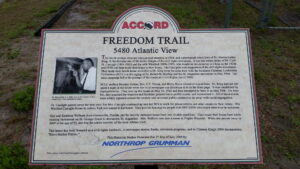 ACCORD Freedom TrailThe ACCORD Freedom Trail in St. Augustine, Florida, is a profound journey through the city's rich Civil Rights…Andrew Young CrossingSet into the pavement along King Street at the Plaza de la Constitución, the Andrew Young Crossing marks…Butler BeachButler Beach stands as one of St. Augustine's most historically significant and naturally beautiful coastal destinations, offering visitors…First Baptist Church (Lincolnville)First Baptist Church of Lincolnville is one of the historic Black churches at the heart of St. Augustine's…Foot Soldiers MonumentThe Foot Soldiers Monument stands in the Plaza de la Constitución, in the heart of downtown St. Augustine,…
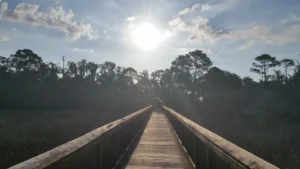 Fort Mose Historic State ParkDiscover one of America's most important yet often overlooked historic sites at Fort Mose Historic State Park, the…
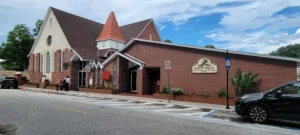 Lincolnville Historic DistrictThe Lincolnville Historic District stands as one of the most significant and inspiring neighborhoods in American history, representing…Lincolnville Museum and Cultural CenterThe Lincolnville Museum and Cultural Center stands as a vital institution for those seeking to delve into the…Monson Motor Lodge siteOn the bayfront at 32 Avenida Menéndez — today the site of a waterfront hotel — once stood…
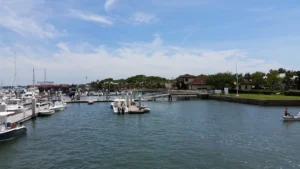 Plaza de la ConstituciónThe Plaza de la Constitución stands as a testament to the rich tapestry of history and culture that…Plaza Public MarketThe market pavilion at the center of the Plaza de la Constitución has stood since the early 1800s…St. Paul AME ChurchSt. Paul AME Church, in the historic Lincolnville neighborhood, is one of St. Augustine's long-standing African American congregations.…The Underground Railroad to Spanish FloridaMost Americans learn about the Underground Railroad that carried enslaved people north to freedom. St. Augustine is home…