
Fort Matanzas National Monument
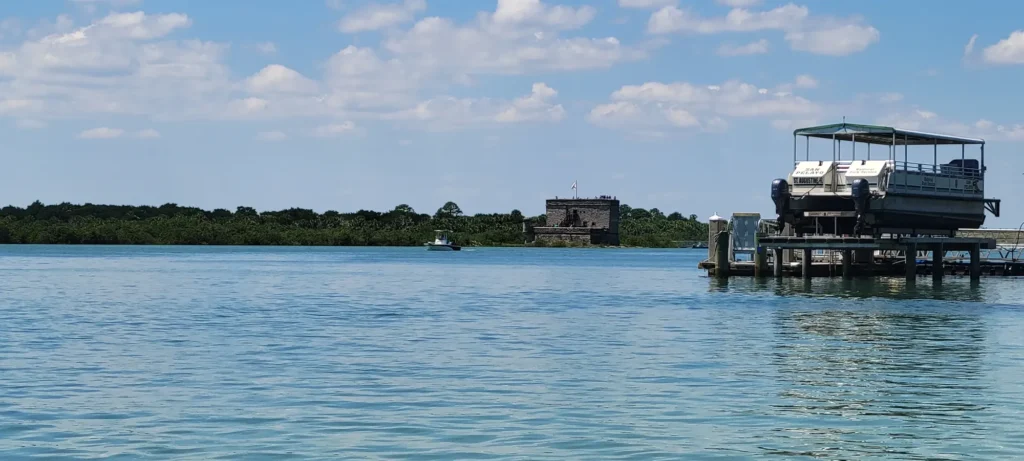
Escape the crowds and discover one of Florida’s hidden treasures at Fort Matanzas National Monument, a beautifully preserved Spanish watchtower standing guard over Rattlesnake Island since 1742. Located just 14 miles south of downtown St. Augustine along scenic Highway A1A, this National Monument offers a unique combination of colonial history, pristine coastal ecosystems, and an unforgettable free ferry ride across the Matanzas River.
The journey to Fort Matanzas is half the adventure. After exploring the excellent visitor center with its exhibits on Spanish colonial life and the fort’s dramatic history, you’ll board a free National Park Service ferry for the short crossing to Rattlesnake Island. The ferry departs every half hour throughout the day, and boarding passes are distributed on a first-come, first-served basis – arrive early during peak season to secure your spot. As you glide across the peaceful waters of the Matanzas River, keep your eyes open for dolphins, manatees, and countless seabirds that call this protected estuary home.
Fort Matanzas itself is a compact but impressive coquina stone watchtower, built to defend St. Augustine’s vulnerable southern approach from British attacks. The name “Matanzas” means “slaughters” in Spanish – a stark reminder of the 1565 massacre when Spanish forces under Pedro Menéndez de Avilés killed over 250 French Huguenots who had wrecked nearby, including the famous French naval commander Jean Ribault. This dark chapter in colonial history gave both the inlet and the fort their ominous name.
The fort you see today was constructed from the same remarkable coquina stone used in the Castillo de San Marcos. This compressed shell-stone, quarried from Anastasia Island, proved virtually indestructible – it absorbed cannonballs rather than shattering, making it the perfect defensive material for Spanish Florida. Despite its small size, Fort Matanzas never saw major combat, though its very presence successfully deterred British naval raids for decades.
Climbing the fort’s narrow spiral staircase takes you to the gun deck, where five cannons once stood ready to protect the vital waterway. The views from the top are spectacular – endless marshes, the winding Matanzas River, and the Atlantic Ocean beyond. You’ll see the large opening in the gun deck that led to a cistern for collecting precious rainwater, essential since Rattlesnake Island had no freshwater source. Imagine the isolation Spanish soldiers endured during their month-long rotations here, with supplies arriving only once monthly from St. Augustine.
Fort Matanzas National Monument preserves far more than just the fort. The park protects approximately 300 acres of pristine Florida coastal environment, including windswept dunes, salt marshes, maritime hammock forest, and beach. Two nature trails wind through these ecosystems – the quarter-mile boardwalk trail through the maritime hammock and a shorter trail through the marsh. Both offer excellent wildlife viewing opportunities, with frequent sightings of herons, egrets, ospreys, and even the occasional bald eagle. In spring and summer, park rangers often lead guided nature walks highlighting the area’s remarkable biodiversity.
The park also features beach access on both sides of A1A. The Atlantic beach (park east of A1A at 8655 A1A South) offers a less crowded alternative to St. Augustine’s main beaches, perfect for shell collecting, surfing, or simply enjoying the waves. Dogs are welcome on the beach and trails (on leash), though they’re not permitted on the ferry or inside the fort itself.
Throughout the year, Fort Matanzas hosts living history demonstrations featuring costumed interpreters who bring the Spanish colonial period to life. Weapon firing demonstrations occur on select weekends, and during summer months, reenactors are often stationed at the fort daily, eager to answer questions and share stories of 18th-century military life.
Best of all, admission to Fort Matanzas is completely free, as are the ferry rides and ranger programs. It’s an incredible value and a perfect complement to visiting the Castillo de San Marcos. Plan for at least two to three hours to fully experience the fort, nature trails, and beach. Bring sunscreen, insect repellent, water, and your camera – Fort Matanzas offers some of the most photogenic and peaceful scenery on Florida’s historic coast.
Good to know
- National Monument - FREE admission and ferry
- Free ferry to fort departs every 30 minutes (weather permitting)
- Boarding passes required - get yours at visitor center
- Fort accessible only by ferry - no private boats
- Allow 2-3 hours for full experience (fort, trails, beach)
- Two nature trails (maritime hammock & marsh) under 1 mile each
- Beach access on both sides of A1A
- Dogs allowed on trails & beach (leash required), NOT on ferry or in fort
- Wheelchair accessible visitor center; fort has stairs
- Living history demonstrations & weapon firings (seasonal)
- Bring sunscreen, bug spray, and water
- Less crowded alternative to Castillo de San Marcos
- Best visited on weekdays or early mornings