
Villa Zorayda: The Moorish Castle That Changed St. Augustine Forever
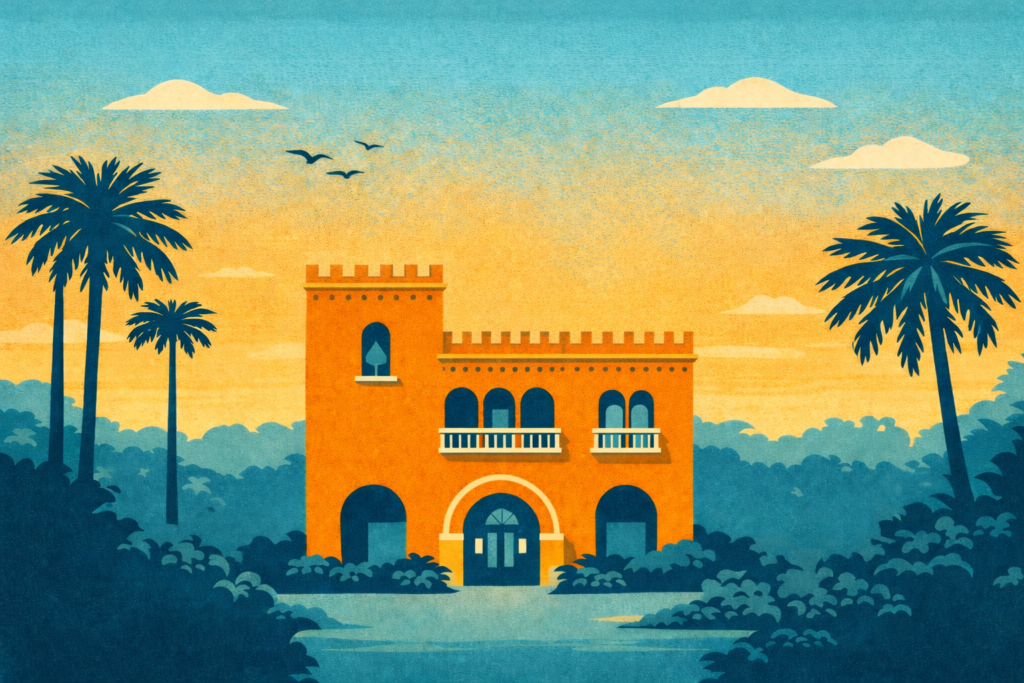
On King Street, wedged between Flagler College and the Lightner Museum, sits a building that looks like it was dropped from another continent entirely. Horseshoe arches, intricate plasterwork, and an unmistakably Moorish silhouette – Villa Zorayda has been stopping people in their tracks since 1883.
It also, inadvertently, gave St. Augustine its architectural identity.
Franklin Smith And The Alhambra
Villa Zorayda was built in 1883 by Franklin W. Smith as his winter home, utilizing Moorish Revival architecture. Smith was a wealthy hardware merchant and architect from Boston, Massachusetts who traveled the world extensively studying ancient civilizations, architecture, and construction methods.
Smith named it “Villa Zorayda” after one of the princesses in Washington Irving’s Tales of the Alhambra. The building is a one-tenth scale reproduction of a portion of the Alhambra Palace in Granada, Spain – one of the greatest architectural achievements of the medieval world brought to a quiet street in northeast Florida.
But the building itself is only half the story. The other half is what Smith built it from.
The Innovation That Built A City
To build the Villa Zorayda, Smith utilized his innovative method of poured concrete construction by mixing Portland cement with locally sourced crushed coquina. It was the first concrete structure in Florida and the very first building of its kind.
Smith’s concrete mix, which used crushed coquina shells as an aggregate, and his method of pouring it in successive levels, was adopted by Henry Flagler for his nearby hotels and churches on an even grander scale. Flagler had never seen this construction method before he arrived in St. Augustine. He was so impressed that he instructed his architects to use it for everything – the Hotel Ponce de Leon (now Flagler College), the Alcazar Hotel (now the Lightner Museum), and the Casa Monica Hotel next door.
In other words, the distinctive look of St. Augustine’s Gilded Age architecture – the buildings that define the city’s skyline and draw millions of visitors every year – traces directly back to one eccentric Boston millionaire and his Moorish winter home.
A Colorful History
Between 1883 and 1933, Villa Zorayda served as a winter residence, and then as a fashionable club, a casino, and a speakeasy. It has hosted gamblers, socialites, bootleggers, and tourists across its 140-year life, accumulating a history as layered as its plasterwork.
The building and part of Franklin Smith’s art and antique collection were sold to Abraham Mussallem, a rug and antiquities merchant originally from Syria, in 1913. The Mussallem family recognized what they had. In 1933, they opened it as a museum. Over 111 years and three generations, the Mussallem/Byles family have been the guardians of the Villa Zorayda.
The building closed in 2000, underwent an extensive eight-year restoration, and reopened in 2008. It was added to the National Register of Historic Places in 1993.
What You Will See Inside
There are magnificent architectural details, including walls made of plaster ground with alabaster using the same molds that were carved by the Moors in the 13th century for the Alhambra Palace, hand-pierced brass lamps, hand-painted tiles, exquisite furnishings, artifacts and priceless antiques from countries around the world.
The collection includes an Egyptian rug over 2,400 years old – one of the oldest surviving rugs in the world. Audio tours are available in English, Spanish, and French and run continuously throughout the day.
The Villa Zorayda Museum offers annual candlelight tours on select evenings during the Nights of Lights celebration, with the building beautifully decorated for the holidays. All tours include homemade cookies and a nonalcoholic beverage.
Visiting
Open daily 10:00 am to 5:00 pm, Sunday 11:00 am to 4:00 pm.
Adult admission: $10. Seniors and military: $9. Children 7-12: $5. Children under 6: free.
Free parking available on site.
Address: 83 King Street, St. Augustine, FL 32084
Website: villazorayda.com