
Mission Nombre de Dios: Where America’s History Began
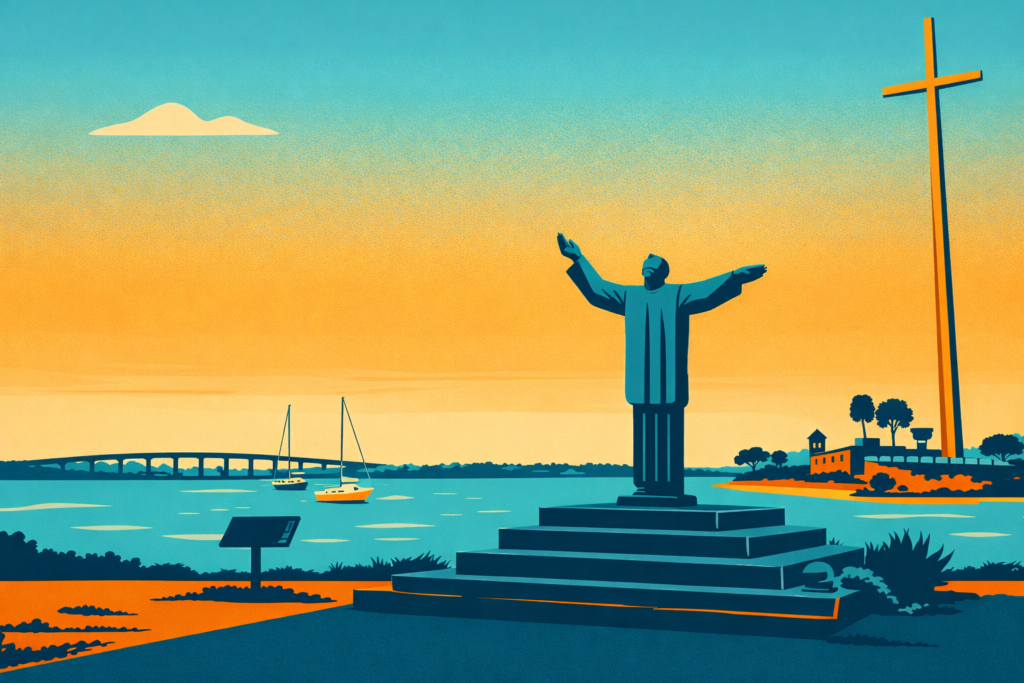
Before the Castillo. Before St. George Street. Before Henry Flagler’s grand hotels. Before any of it – there was the landing.
On September 8, 1565, Pedro Menéndez de Avilés landed and proclaimed this site for Spain and the church. Menéndez named this site Nombre de Dios, meaning “Name of God.” He put Father Lopez in charge of the mission, making him the first parish priest in St. Augustine. On these grounds, Father Lopez celebrated the first parish Mass and began work at America’s first mission.
That spot, just north of downtown St. Augustine on San Marco Avenue, is still there. You can walk it today.
The Sacred Acre
The grounds of Mission Nombre de Dios have been called America’s most sacred acre, and it is not hyperbole. Mission Nombre de Dios is likely the oldest extant mission in the continental United States. The National Shrine of Our Lady of La Leche, the oldest Marian shrine in the country, is located on the mission grounds.
What greets you when you arrive is the Great Cross – an unmistakable landmark visible from across the Matanzas Bay. Erected in 1965 to celebrate the city’s 400th birthday, this gleaming stainless steel cross is 208 feet in height, the tallest free-standing cross in the western hemisphere. It marks the location where the Spaniards came ashore to proclaim the site of St. Augustine in the Name of God. Illuminated at night, the Great Cross is one of St. Augustine’s most distinctive and inspiring features.
The Mission And The Timucua
The Franciscans were particularly successful in the Mocama village known as Nombre de Dios, converting the chief and her daughter. By 1587, the Franciscans had established the Mission of Nombre de Dios at a Timucuan town on the outskirts of St. Augustine. Their success was largely owing to Doña María Meléndez, the ruling chief of the town.
Doña María was more than a convert. She was a political leader who saved the struggling colony from starvation in 1587 by supplying the Spanish settlers with corn when they were overwhelmed by refugees and shipwreck survivors. The relationship between the mission and the Timucua people was complicated – shaped by genuine faith on both sides and by the brutal realities of colonialism that ultimately devastated the indigenous population within a few generations.
The Shrine Of Our Lady Of La Leche
In the early 1600s, Spanish settlers and newly-converted Native Americans in St. Augustine established the first shrine to the Blessed Virgin Mary in what is now the United States. The shrine is dedicated to motherhood, and for centuries women have made pilgrimages here seeking blessings for pregnancy and safe delivery.
The first shrine was erected around 1677, likely built by skilled craftsmen working on the Castillo de San Marcos. The chapel was destroyed by the British in 1728, rebuilt, destroyed by a hurricane, rebuilt again. The current ivy-covered chapel, which seats about 30 people, was built in 1914 and is a replica of previous chapels built of coquina. In 2019, the United States Conference of Catholic Bishops elevated the shrine to national shrine status.
The Museum
The Mission Nombre de Dios Museum opened in 2010 and does not charge an admission fee. Its exhibits include the original casket of Pedro Menéndez de Avilés, founder of the city of St. Augustine, dating to 1574, artifacts uncovered during archaeological excavations, and a replica of the oldest written European documents in the United States.
Visiting
The mission grounds are open from dawn to dusk. The gift shop and museum are open Monday through Saturday from 10:00 am to 4:00 pm and Sunday from noon to 4:00 pm. Admission is free. Only service animals are allowed on the grounds. Plan at least an hour. The grounds are quiet, shaded, and genuinely moving.
Parking note: Non-religious visitors can park free for the first hour. After that, fees apply through the Passport Parking App.
Address: 101 San Marco Avenue, St. Augustine, FL 32084
Phone: (904) 824-2809
Website: missionandshrine.org
Plan your visit: Mission Nombre de Dios