
Henry Flagler in St. Augustine: The Man Who Turned the Ancient City Into a Winter Resort
St. Augustine was already old when Henry Flagler arrived.
That sounds obvious, but it matters. This was not a blank canvas. This was a Spanish colonial city with a fort, old streets, old families, Black history, Minorcan history, Catholic history, military history, and centuries of survival behind it. St. Augustine did not begin with Flagler.
But the St. Augustine most visitors walk through today? The grand hotels, the towers, the courtyards, the sense that the city is not just old but theatrical, polished, and designed to be experienced by outsiders? That part of St. Augustine owes an enormous amount to Henry Morrison Flagler.
Flagler was not a small-town booster with a dream. He was one of the richest and most powerful businessmen in America. He had made his fortune as a founding partner of Standard Oil alongside John D. Rockefeller, helping build one of the most profitable corporations of the age. After oil made him wealthy, Florida became his second act. In St. Augustine, he saw something most people had not yet fully imagined: a historic Southern coastal city that could become the first great winter playground for America’s northern elite.
That vision changed St. Augustine forever. It also came with consequences.
Flagler’s First Look at St. Augustine
Flagler first came to St. Augustine in the early 1880s, when Florida tourism was still primitive compared with what it would become. Wealthy northerners did travel south in winter, but Florida was not yet the easy, polished resort machine people know today. Roads were rough. Rail service was limited. Hotels were inconsistent. St. Augustine had charm, history, and climate, but it did not yet have the infrastructure to receive the richest people in America in the style they expected.
Flagler saw the problem and the opportunity at the same time.
He was impressed by the city, but he was also dissatisfied with its accommodations. That is the Flagler pattern in a nutshell. He did not just admire a place. He looked at it like an industrialist. If the hotel was not good enough, build a better hotel. If the railroad did not reach far enough, buy or build the railroad. If the city needed utilities, support the utilities. If the wealthy needed a reason to come, create a resort grand enough to make the journey fashionable.
This is how St. Augustine became the test case for Flagler’s Florida vision.
The Hotel Ponce de Leon
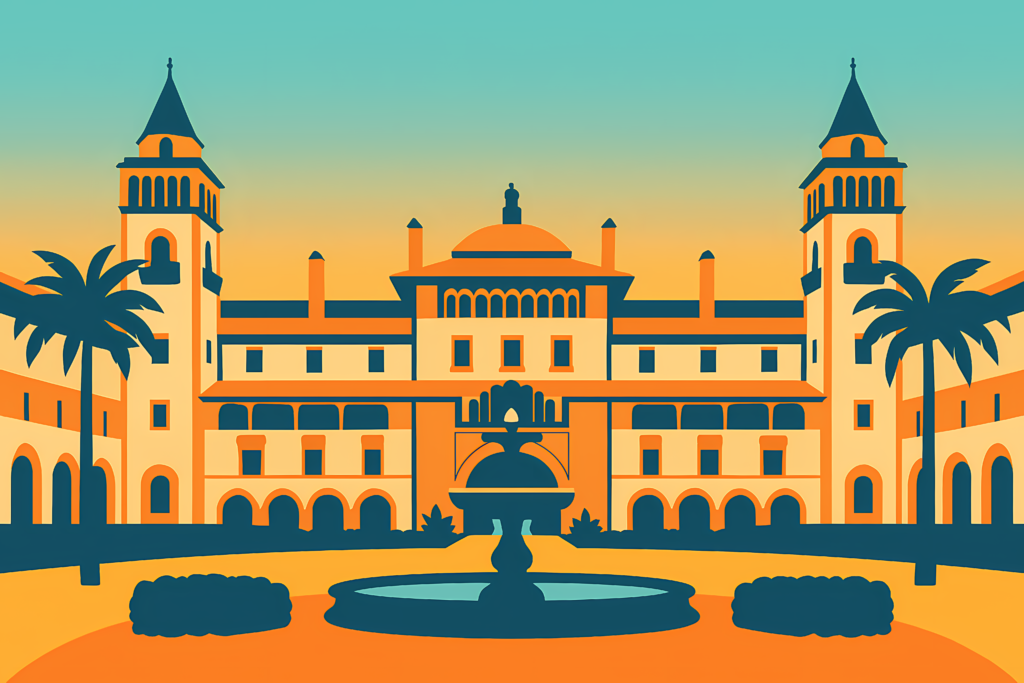
Flagler’s masterpiece in St. Augustine was the Hotel Ponce de Leon, now the centerpiece of Flagler College. Construction began in 1885, and the hotel opened in January 1888. It was not just a hotel. It was a statement.
The Ponce was designed by the young architectural firm Carrère and Hastings, who later became famous for projects including the New York Public Library. In St. Augustine, they created a Spanish Renaissance Revival fantasy palace with towers, courtyards, arches, red tile, murals, fountains, and a level of interior detail that still stops visitors in their tracks today. Louis Comfort Tiffany contributed to the interiors, and the building was one of the early major American buildings designed with electricity in mind.
That last part is important. The Ponce was not only romantic-looking. It was technologically ambitious. It used poured concrete with local coquina aggregate, a bold construction method at the time. It had electric lighting when many guests were still nervous about touching switches. It had scale, luxury, novelty, and mythology all wrapped together.
For St. Augustine, the message was clear: this ancient city could compete with the grand resorts of Europe and the Northeast. Visitors could come for Spanish atmosphere without leaving the United States. They could enjoy history, sunshine, architecture, and elite social life in one place.
The Ponce made St. Augustine fashionable.
The Hotel Alcazar
Once the Ponce succeeded, Flagler expanded. Across King Street, he built the Hotel Alcazar, now the Lightner Museum. The Alcazar opened in 1888 and was designed by the same architects, Carrère and Hastings. At first, it functioned partly as a recreation and entertainment companion to the Ponce, but it became a major hotel in its own right.
The Alcazar had amenities that sound modern even now: a large indoor swimming pool, baths, recreation spaces, entertainment, and social facilities for guests who wanted leisure to be part of the experience. Today, when you walk through the Lightner Museum, you are not just walking through a museum building. You are walking through the remains of Flagler’s resort ecosystem.
The Ponce was the grand palace. The Alcazar was the pleasure complex. Together, they turned King Street into one of the most impressive Gilded Age resort corridors in the South.
Other Flagler Buildings Still Standing
Flagler’s St. Augustine was not limited to the two big hotels. He purchased the Casa Monica Hotel from Franklin Smith and reopened it as the Cordova. Today, the Casa Monica still stands as one of the major historic hotels downtown. He also built or supported other pieces of the city’s Gilded Age infrastructure, including the Florida East Coast Railway offices and the Memorial Presbyterian Church, where Flagler is buried.
That is one of the strange things about visiting St. Augustine today. You can spend a full day walking Flagler’s footprint without necessarily meaning to. Flagler College, the Lightner Museum, Casa Monica, Memorial Presbyterian, the old railroad-related buildings, the layout of King Street tourism, even the city’s self-image as a historic luxury destination all carry his fingerprints.
He did not invent St. Augustine, but he reframed it.
The Railroad Was the Real Engine
The hotels get the attention because they are beautiful. The railroad is what made the whole thing work.
Flagler understood something basic: luxury hotels in Florida meant nothing if rich guests could not get there comfortably. So he began buying and improving rail lines, eventually building the Florida East Coast Railway system. What started as a way to bring guests to St. Augustine became a transportation project that reshaped the entire east coast of Florida. The railroad eventually connected Jacksonville to Key West, with the famous Over-Sea Railroad completed in 1912.
This is where the St. Augustine story becomes the Florida story. Flagler tested the model here: resort plus rail, luxury plus infrastructure, tourism plus real estate. Then he pushed south. Ormond Beach, Palm Beach, West Palm Beach, Miami, and eventually Key West all became part of the larger Flagler vision.
St. Augustine was not the end of the plan. It was the beginning.
The Labor Behind the Luxury
Here is where the story needs to slow down.
The postcard version of Flagler’s St. Augustine is all towers, courtyards, stained glass, famous guests, and elegant verandas. But those buildings did not rise by magic. They were built, staffed, cleaned, cooked for, maintained, and powered by workers whose names were not preserved with the same enthusiasm as the architects and millionaires.
Black labor was central to the construction and operation of Flagler’s St. Augustine hotels. Florida’s Historic Coast directly notes that Black men built the Hotel Ponce de Leon, and the Lightner Museum has documented the large, diverse working-class staff required to operate hotels like the Ponce, Alcazar, and Cordova. These workers lived in separate quarters, worked behind the scenes, and made the luxury experience possible while rarely being centered in the public memory of the buildings.
There is also a broader immigrant labor story around Flagler-era Florida, including Cuban and Caribbean workers tied to railroad, hotel, and development labor across the state. That part of the record is often harder to see in the standard tourist version of St. Augustine, which is exactly the point. Gilded Age buildings tend to preserve the names of owners, architects, and guests. They are less reliable at preserving the lives of the people who mixed concrete, hauled materials, served meals, washed linens, laid track, and kept the entire machine running.
So when we admire Flagler’s buildings, we should admire the craft too. Not just the patron.
The Vision and the Consequences
Flagler’s vision was brilliant. It was also disruptive.
Before Flagler, St. Augustine was historic, but it was not yet a luxury resort city on the national stage. After Flagler, it became a destination for presidents, industrialists, writers, artists, and wealthy winter travelers. That brought money, jobs, infrastructure, attention, and preservation energy. Without Flagler, it is hard to imagine the Ponce, the Alcazar, or the city’s later tourism identity existing in the same form.
But development always chooses winners and losers. Flagler’s St. Augustine catered to wealthy outsiders. It elevated certain versions of the city’s history while pushing other stories into the background. Spanish romance sold better than Black labor history. Gilded Age grandeur photographed better than working-class neighborhoods. The city became more accessible to tourists, but also more shaped by tourist expectations.
And then there is the broader Flagler legacy in Florida. His railroad opened the east coast to settlement, tourism, land speculation, and rapid development. That helped create modern Florida. It also accelerated the transformation of fragile coastal environments and contributed to the pattern we still live with today: build access, sell paradise, repeat.
That is not a simple legacy. It is not all heroic, and it is not all villainous. It is Florida.
The Complicated Man
Flagler was a visionary, but he was also a Gilded Age titan. That phrase should make us cautious. The Gilded Age produced spectacular buildings and brutal inequalities. It produced philanthropy and monopoly power, beauty and exploitation, innovation and social damage.
Flagler helped create modern Florida tourism. He also benefited from a system where enormous wealth gave one man the power to reshape cities, rail lines, labor markets, and landscapes. In St. Augustine, he left behind some of the most beautiful buildings in the state. He also left behind a version of history that visitors are still learning how to tell more honestly.
The best way to understand Flagler is not to flatten him. He was not merely the kindly father of Florida tourism. He was not merely a robber baron in a white suit. He was both builder and businessman, dreamer and controller, preservation force and development force. He made St. Augustine more famous. He also made it more dependent on visitors.
That tension is still here.
What St. Augustine Might Look Like Without Him
Without Flagler, St. Augustine would still matter. The Castillo would still stand. St. George Street would still have its bones. The city would still be the oldest continuously occupied European-founded city in the continental United States. Fort Mose would still matter. Lincolnville would still matter. The Spanish, Minorcan, Black, military, maritime, and religious layers of the city would still be here.
But the city would look and feel different.
There might be no Flagler College campus inside a former palace hotel. No Lightner Museum inside the Alcazar. No Casa Monica as part of that same Gilded Age streetscape. King Street would not have the same theatrical entrance into downtown. St. Augustine might have remained a smaller historic town, important but less glamorous, visited more for colonial history than resort architecture.
Flagler gave the city scale. He gave it spectacle. He gave it a second identity layered on top of the first.
That is why we tell visitors to look twice. When you stand in the courtyard at Flagler College, do not just see a pretty building. See the oil fortune behind it. See the architects. See the workers. See the wealthy guests arriving by rail. See the Black laborers and hotel staff whose stories were not carved into the façade. See the city becoming a product, not just a place.
Henry Flagler did not create St. Augustine.
But he absolutely created the St. Augustine many visitors think they came to see.